

Pull up to any petrol station on a Sunday morning and you’ll find riders in heated debate — throttle maps, suspension settings, exhaust notes. But ask the one guy who’s been riding the longest what actually makes or breaks a motorcycle, and he’ll look down before he answers.
The tires. It’s always the tires.
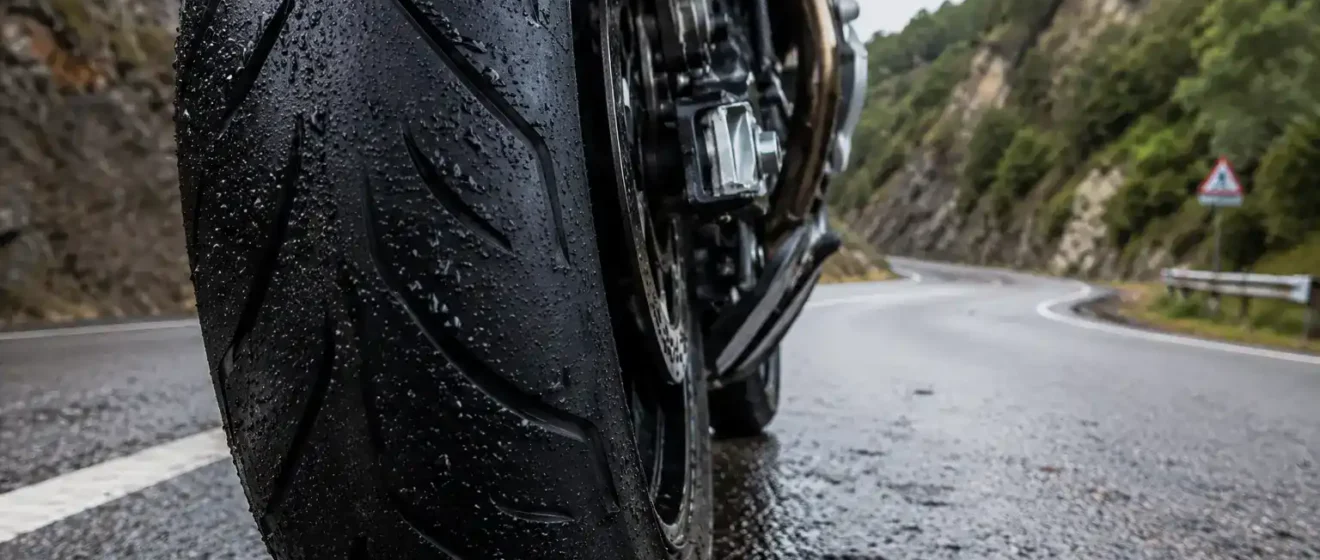
No matter what sits between your ears or under the tank, the only things connecting you to the road are two contact patches roughly the size of your palms. That’s it. Two hand-sized ovals of rubber doing everything — accelerating, braking, cornering, absorbing road shocks, keeping you vertical in the wet. When they’re right, you barely think about them. When they’re wrong, you feel it in your gut before you can put words to it.
The problem is that buying motorcycle tires has gotten complicated. There are more options than ever, and the marketing language — multi-compound, silica-infused, dual-radius profile — doesn’t always tell you what you actually need to know before handing over your money.
This is the motorcycle tire buying guide that cuts through that. Whether you’re replacing your first set, trying to understand why your rear wore out in 4,000 miles, or shopping for a tire that can handle both a week-long touring trip and a spirited Saturday morning run, this guide has your answer. We cover everything — types, compounds, sizes, brands, lifespan, maintenance, and the mistakes that cost riders money every year.
Let’s start with the thing most buyers skip entirely: understanding why tires matter as much as they do.
1. Why Motorcycle Tires Matter More Than Anything Else on Your Bike
This isn’t hyperbole. Your engine produces the power. Your suspension manages the weight. Your brakes generate the stopping force. But none of that does a thing if the rubber isn’t gripping the road properly. Tires are the final translation layer between everything your bike is trying to do and what actually happens.
Safety — The One That Actually Keeps You Up at Night
A motorcycle has no crumple zones, no airbag, no electronic stability control that can compensate for a tire that’s lost grip. The tire is it. The right tire on a wet road means you get around that unexpected bend. The wrong one — old, under-inflated, wrong compound for the conditions — means you don’t. There’s no softening that reality.
Traction — More Nuanced Than You Think
Traction isn’t just ‘does it grip or doesn’t it.’ It’s about how the rubber compound interacts with road micro-texture at different temperatures, how the tread evacuates water at 60 mph, how much the tire deforms against a gravelly surface versus smooth tarmac. A tire designed for hot, dry canyon roads feels genuinely nervous on a cold, damp Tuesday morning commute. Understanding compound behaviour is the difference between confidence and anxiety behind the bars.
Handling — Feel Through the Bars
The tire’s profile shape — its cross-section — determines how your bike transitions from upright to lean. A round-profile sport tire lets you tip in quickly and roll from lean to lean with fluid ease. A flatter touring tire gives you that rooted, planted feel at motorway pace. Fit the wrong profile and the steering feels either heavy and reluctant or twitchy and nervous. Good tires disappear beneath you. You stop noticing them and just ride.
Braking — Where Margins Are Smallest
Your ABS is only as good as the grip the tire can generate. A worn tire — even one that looks like it still has tread — reduces braking performance in ways that don’t announce themselves until you need an emergency stop. In city traffic, with cars pulling out and pedestrians stepping off curbs, those extra feet of stopping distance are the whole story.
Comfort — Hours in the Saddle Tell the Truth
Tires absorb vibration before it reaches the frame. A well-matched tire with the right sidewall flex smooths out the relentless chop of urban tarmac and motorway joints. An over-inflated, wrong-spec, or aged tire transmits every imperfection straight to your wrists and lower back. You don’t notice it on a 20-minute ride. On hour six of a touring day, you notice nothing else.
Fuel Economy — Not Glamorous, But Real
Rolling resistance costs you fuel. Harder compounds and properly inflated tires roll more efficiently than soft or under-inflated ones. On a touring bike covering 15,000 miles a year, the cumulative difference across a tire’s lifespan is measurable at the pump.
2. Tire Anatomy — What’s Actually Inside That Rubber
You don’t need an engineering degree to buy tires, but knowing what you’re looking at changes how you read the marketing and the spec sheets. Here’s what’s actually built into a motorcycle tire.
What’s Inside the Tire
At the core is the carcass — woven cords of nylon, polyester, or aramid that give the tire its structural backbone. Wrap around that with the belt package — steel or fabric layers that stabilize the tread and resist centrifugal expansion at speed. On top sits the tread compound, and down the sides run the sidewalls, which contribute to ride flex and protect the inner structure from kerb strikes and road debris. Inside a tubeless tire, a rubber inner liner seals it all against the rim.
Reading the Sidewall Code
That string of numbers on the sidewall isn’t cryptic once you know the logic. Take: 120/70 ZR17 (58W)
- 120 — Section width in millimetres. How wide the tire measures when correctly inflated on the right rim.
- 70 — Aspect ratio. The sidewall height is 70% of 120mm, so 84mm tall. Lower numbers mean a shorter, stiffer sidewall — sportier but harsher.
- ZR — ‘R’ means radial construction (the cords run perpendicular to the direction of travel). ‘Z’ is a legacy high-speed designation.
- 17 — Rim diameter in inches.
- (58W) — Load and speed. 58 = maximum 236 kg load. W = rated to 270 km/h.
The brackets around (58W) indicate the tire has been tested at sustained high speeds beyond what the letter alone implies. Pay attention to the load index especially on touring bikes loaded with luggage and a pillion.
Tube vs Tubeless — Which Do You Have?
Most modern bikes with cast alloy wheels run tubeless tires. They seal directly against the rim — if you pick up a nail, you typically get a slow leak rather than an instant deflation. Spoke wheels on adventure bikes and classics usually require tube-type tires, where a puncture means faster air loss. Some spoke wheels can be retrofitted for tubeless use with the right tape and valve stems, which many touring ADV riders do for peace of mind on long trips.
3. Types of Motorcycle Tires
This is where most riders get lost — or get swayed by the wrong thing. Here’s an honest breakdown of each tire category, including who should actually be buying them.
Sport Tires
These are the tires that make your sport bike feel the way it was designed to feel. Soft, grippy compounds, a round profile for rapid direction changes, and construction built for the kind of cornering loads that would destroy a touring tire in a weekend. They warm up fast, communicate beautifully through the bars, and on a dry twisty road, nothing touches them.
- Best for: Weekend sport riders, mountain passes, track days with road-legal requirements.
- Mileage: 4,000–7,000 miles, sometimes less if you’re really working them.
- Trade-off: They’re consumables. Accept that going in.
- Ideal rider: Anyone on a supersport or naked bike who genuinely pushes on weekends.
Sport Touring Tires
The category that sells the most for a reason. Sport touring tires use dual-compound construction — harder rubber in the centre strip that handles the straight-line miles without wearing through, softer rubber on the shoulders where cornering loads demand grip. The result is a tire that does 10,000+ miles, feels confident in the wet, and still inspires trust when you lean into a good corner. The Michelin Road 6 and Bridgestone Battlax T32 are the reference points in 2026.
- Best for: Long weekend trips, regular commuting, mixed-use riding.
- Mileage: 8,000–13,000 miles depending on riding style.
- Trade-off: Not quite as sharp as a dedicated sport tire at the absolute limit.
- Ideal rider: Most of us, honestly.
Touring Tires
Built for the big miles. Touring tires prioritise longevity above everything else — 15,000 to 20,000+ miles is achievable — along with the load-carrying capacity that heavy touring bikes demand. They run harder compounds, a flatter profile for high-speed stability, and reinforced carcasses. They’re not exciting. They’re not supposed to be.
- Best for: Long-haul touring, two-up riding with full luggage.
- Mileage: 12,000–20,000+ miles.
- Trade-off: Need more warm-up time, less feedback at lean.
- Ideal rider: Gold Wing, RT-series BMW, and big adventure tourer owners.
Cruiser Tires
Cruiser tires serve a very specific master — the geometry, weight, and torque characteristics of V-twin cruisers. They often feature wider rear sections, distinctive tread patterns, reinforced sidewalls for torque loads, and a profile suited to bikes that don’t lean far but carry a lot of weight low and forward. The Dunlop American Elite and Michelin Commander III are benchmarks because they were actually designed for this kind of machine.
- Best for: Harley-Davidson, Indian, and metric cruiser riders.
- Mileage: 10,000–18,000 miles.
- Trade-off: Not built for aggressive lean angles.
Adventure (ADV) Tires
The adventure category has exploded in the last decade, and so has the tire market for it. ADV tires are typically rated 70/30 or 80/20 on-road to off-road. On tarmac they handle like a decent sport-touring tire; on gravel and dirt tracks they hold their composure in a way a pure road tire never could. Get the balance right for your actual riding — if 90% of your miles are tarmac, go 80/20. If you’re genuinely seeking out the rough stuff, go 50/50.
- Best for: Gravel roads, forest tracks, overlanding with tarmac connections.
- Mileage: 7,000–12,000 miles.
- Trade-off: Can’t match pure road tires on tarmac, can’t match knobbies in deep mud.
- Ideal rider: GS, Africa Twin, KTM Adventure, Tenere owners.
Dual Sport Tires
Where ADV tires lean toward the road, dual sport tires lean toward the dirt. A 50/50 split means actual off-road traction — these grip in ruts, loose gravel, and hardpack where an ADV tire would feel vague. The trade-off on road is real: more noise, slight instability at motorway speeds, and faster centre-tread wear on tarmac. But if you’re spending real time off the beaten path, this is the right tool.
- Best for: Trail networks connected by paved sections.
- Mileage: Highly variable — 4,000–8,000 miles.
Off-Road / Motocross Tires
Knobbies. Widely spaced lugs that dig into soft earth, expel mud, and hook up in sand and hardpack. Absolutely useless on tarmac — they wear rapidly, handle unpredictably, and aren’t road legal in most places. If you’re racing or doing serious enduro, you know what you need here.
Track / Racing Tires
Slicks or near-slicks. The rubber compound is so soft it produces extraordinary grip levels — but only once the tire is at operating temperature, which requires tire warmers. Cold slicks on a public road are genuinely terrifying. These are track-day tools, full stop. Do not let a fast lap time or a magazine test convince you otherwise.
4. How to Choose the Right Tire for Your Riding
Here’s the honest version: the best tire for you is the one that matches how you actually ride, not how you’d like to think you ride. Most of us put in 70% of our miles commuting and doing mundane A-to-B journeys. Be honest about that when you’re choosing.
Start With Your Bike
Your manufacturer picked an OEM tire size and type for reasons. The geometry, load ratings, and handling characteristics were developed and tested around a specific tire spec. Going wider on the rear might look great in photos but it changes your steering geometry in ways you’ll feel every corner. Start with OEM size. Research deviations carefully before making them.
Match the Tire to Your Riding Style, Not Your Fantasy
If you commute daily through city traffic with an occasional weekend run, a sport-touring tire is going to serve you far better than a sport tire. You’ll get twice the mileage, better cold-weather grip on those morning commutes, and more predictable wear. Save the sport rubber for when you’re genuinely pushing on the right roads.
Think About Your Weather
Riders in the UK, the Pacific Northwest, and northern Europe should prioritise wet-weather performance. High-silica compounds stay pliable in cold temperatures and channel water more effectively. In hotter, drier climates like southern Spain or the Australian interior, you can trade some wet performance for a harder compound that lasts longer. Riding year-round through all seasons? Sport-touring tires with a strong all-weather rating are made for you.
Road Surface Matters More Than You Think
Smooth motorways and sweeping A-roads favour performance-biased tires. Cracked urban back streets, potholed city roads, and mixed surfaces call for a tire with good sidewall flex and a robust carcass that absorbs impacts without transferring every bump to your hands. Gravel? You need the right ADV spec — no road tire handles loose surfaces with any confidence.
Do the Mileage Maths
If you cover 15,000 miles a year and a sport tire lasts 6,000 miles, you’re buying two and a half sets annually. A sport-touring tire at 12,000 miles means just over one set. At £150–200 per tire, the annual cost difference is significant. Factor that into your decision.
Budget Honestly
There is a genuine quality difference between premium and budget tires — particularly in wet grip, compound consistency across temperatures, and predictable wear patterns. That said, a budget tire isn’t dangerous by default. For light urban use on an older bike, a Shinko or similar value-brand tire does the job. Where it falls short is in the demanding scenarios — cold morning cornering, emergency braking in the wet — where premium compound technology earns its price.
Real-World Buyer Scenarios
- Daily city commuter, 6,000 miles/year, mixed weather: Michelin Road 6 or Bridgestone T32. Long-wearing, excellent wet grip, good cold-weather performance.
- Weekend sport rider on a naked or supersport, mostly dry: Pirelli Diablo Rosso IV or Dunlop SportSmart TT. You want to feel the road.
- BMW GS or similar ADV, long-distance touring with gravel: Metzeler Tourance Next 2 or Michelin Anakee Road 2.
- Harley-Davidson cruiser, mostly highway and urban: Dunlop American Elite or Michelin Commander III. Built for the weight and torque.
- Track day rider who also rides to the circuit: Pirelli Diablo Supercorsa SP — as close to race rubber as street-legal gets.
5. Tread Patterns — More Than Just Good Looks
The tread pattern isn’t decorative. Every groove, sipe, and void has a specific job, and understanding what they do helps you read a tire’s character before you buy it.
Symmetrical Tread
The same pattern on both sides of the centre line. Common on sport-touring tires. Offers balanced wet and dry performance, no directional restrictions, and a progressive feel through the full lean range.
Directional Tread
V-shaped grooves that point into the direction of travel. Water is funnelled outward and rearward as the tire rotates, keeping the contact patch cleaner in heavy rain. These tires have a marked rotation direction on the sidewall — fit them backwards and they actively collect water rather than dispersing it. Strong choice for wet-climate riders.
Adventure Tread
Larger tread blocks with more space between them — a higher void ratio. That void is what grabs loose surfaces and self-cleans mud from the contact patch. The bigger and more widely spaced the blocks, the better the off-road grip, and the noisier and less stable the tire becomes on tarmac. It’s a sliding scale, and different ADV tires sit at different points on it.
Knobby Tread
Individual lugs spaced widely apart. Designed to hook into soft terrain and release cleanly. On a hard road surface they rock from knob to knob rather than rolling smoothly, which creates the characteristic vibration and noise of off-road tires on tarmac. This is not a street tire.
Wet vs Dry Grip — The Fundamental Trade-off
More void means more water-evacuation channels and better wet traction. Less void means more rubber contact with a dry surface, which means more grip on dry roads. Tyre engineers balance these competing needs based on what the tire is designed to do. A wet-optimised tire with heavy siping will feel slightly vague on a hot, dry track compared to a semi-slick with minimal void. A dry-bias tire will feel skittish on a rain-soaked urban road.
Noise and Longevity
Knobbier, higher-void patterns generate more road noise — the tread blocks vibrate as they contact and leave the road surface. Dense, continuous-tread patterns are quieter but wear differently under load. If long days on a touring bike make road noise a factor for you, look specifically for tires marketed for low noise — Michelin and Continental both publish noise ratings on their touring lines.
6. Tire Compounds — The Science Behind the Grip
The compound is where the real engineering happens. Two tires can look identical from the outside and behave completely differently because of what the rubber is made of.
Soft Compound — Feel Everything, Wear Fast
Soft compounds deform easily against road micro-texture. That deformation increases the real contact area between rubber and road, which is where grip actually comes from. Sport tires live here. The trade-off is heat generation — those deformations create friction, and over thousands of miles, that friction wears the compound away. A soft tire that feels incredible at 4,000 miles is reaching the end of its useful life.
Medium Compound — The Daily Reality
Medium compounds balance grip with longevity. Sport-touring tires typically use medium compounds on the shoulder edges — where cornering grip is critical — transitioning to a harder mix in the centre where wear accumulates fastest. It’s engineering compromise in the most practical sense of the phrase.
Hard Compound — Built for the Long Haul
Touring and cruiser tires run harder compounds that resist wear over long distances. The trade-off is a longer warm-up time before the compound reaches its operating temperature and starts gripping fully. On a cold, damp morning, a hard-compound touring tire needs a few careful miles before it’s working properly. Not a problem on the open road. Worth knowing when you’re pulling out of a cold garage.
Dual-Compound Technology
Modern tire manufacturing can lay different compounds side by side in the same tire. A harder strip through the centre handles the straight-line mileage, and softer rubber on the outer edges delivers cornering grip. The transition between the two is engineered to be seamless. This is the technology that lets a sport-touring tire do 12,000 miles without feeling like a compromise in the corners.
Multi-Compound — Taking it Further
Some premium tires use three or more distinct compounds across the tread width, with additional blending zones between them. Michelin’s Power 5 and Pirelli’s Diablo Rosso IV both use multi-compound construction. The idea is a tire that behaves differently — intentionally — depending on lean angle and load. At single-figure lean it prioritises wear resistance; at 40 degrees of lean it’s optimised for grip. It’s genuinely impressive technology, and it shows in the pricing.
7. How to Read Motorcycle Tire Sizes
The size code on a motorcycle tire looks more complicated than it is. Break it down once and you’ll read it confidently for the rest of your riding life.
The Modern Metric System
Standard format: 190/55 ZR17 (75W). Reading left to right:
- 190 — Section width in millimetres when correctly inflated on the specified rim.
- 55 — Aspect ratio. The sidewall height is 55% of 190mm = 104.5mm. Lower number = shorter, stiffer sidewall.
- ZR — Construction type. R = radial. Z = high-speed designation (legacy, still widely used).
- 17 — Rim diameter in inches.
- (75W) — Load index and speed rating. 75 = 387 kg maximum load per tire. W = rated to 270 km/h sustained.
The Older Alpha-Numeric System
Older bikes sometimes specify tires in alpha-numeric format, such as MT90B16. ‘MT’ is the width designation, ’90’ is the aspect ratio, ‘B’ means bias-ply construction, and ’16’ is the rim diameter in inches. If your bike runs this sizing, you’ll need to either source tires in that format or use a cross-reference chart to find a compatible metric equivalent — your dealer can help with this.
OEM Sizes and Why They Exist
The manufacturer specified your tire size after testing the bike’s handling, braking, and stability against that exact spec. Going wider on the rear looks aggressive but changes your steering geometry — the bike sits differently, which alters how it steers. Going narrower reduces load capacity. Changing the aspect ratio changes ride height and therefore chain tension and geometry. None of these are necessarily disastrous changes, but they’re all intentional changes with real consequences.
The Mistakes People Make
- ‘Wider rear = more grip’: The contact patch shape matters more than raw width. A correctly sized tire in the right compound outgrips an oversized tire in the wrong one.
- Mismatched profiles: A very round-profile front tire paired with a very flat-profile rear creates inconsistent steering through transitions. Tires within a matched pair are designed to work together.
- Ignoring load index: On a fully loaded touring bike with two riders and luggage, fitting a tire rated below the combined load is a structural and safety issue, not a minor spec discrepancy.
8. How Long Should Your Tires Last?
The honest answer is: it depends. Mileage ranges in any tire review are based on average riders in average conditions. Your conditions probably aren’t average. Here’s how to calibrate your expectations.
Realistic Mileage Ranges by Category
- Sport tires: 4,000–7,000 miles. Push hard on weekends and you’ll be at the lower end.
- Sport-touring tires: 8,000–13,000 miles. The most consistent performers here.
- Touring tires: 12,000–20,000+ miles. Some hard-compound touring tires have gone further.
- Cruiser tires: 10,000–18,000 miles, with wide variation by riding style.
- ADV tires: 7,000–12,000 miles on tarmac, significantly less if you’re doing real off-road.
What Ages a Tire Faster Than Miles
Age matters independently of mileage. Rubber oxidises, compounds lose plasticisers, and the tire degrades whether it’s on a bike or sitting in your garage. A five-year-old tire with 30% tread remaining is not a new-ish tire with good miles left — it’s an old tire that hasn’t been used enough. Most manufacturers and tyre safety bodies recommend replacement at five years regardless of tread depth. The DOT code on the sidewall tells you the manufacture date: look for the last four digits (e.g., ‘2423’ = week 24 of 2023).
The Wear Accelerators
- Under-inflation: The most damaging thing you can do to a tire. Under-inflation causes excessive sidewall flexing, which generates heat, which degrades the compound and internal structure. It also concentrates wear in the outer edges.
- Over-inflation: Reduces contact patch size and concentrates wear in the centre strip. Feels harsh, wears unevenly, and reduces wet grip.
- Hard acceleration and braking: The highest-stress inputs for rear and front tires respectively. Track day riders burn through tires faster because of this.
- Road surface: Abrasive chip-seal rural roads wear tires measurably faster than smooth motorway tarmac.
- Temperature: Sustained high ambient temperatures soften compounds, which increases wear rate. If you’re touring in extreme heat, check your tires more frequently.
9. When to Replace — The Signs You Can’t Ignore
A tire that looks fine from three feet away isn’t necessarily fine. Here’s what to actually look for.
Tread Wear Indicators
Moulded into the bottom of the main tread grooves are small raised bars — tread wear indicators (TWI). When the surrounding tread wears down to the level of these bars, you’re at the legal minimum (typically 1.0–1.6mm depending on country). In practice, don’t ride to the indicators. By the time you’re close, wet-weather grip has already degraded significantly. Plan your replacement at 2mm or earlier.
Sidewall Cracking
Fine surface cracks in the sidewall, particularly in the groove areas, are a sign of chemical degradation from age and UV exposure. If you can see cracking, the tire is compromised regardless of tread depth. This is one of the most common things people miss when buying secondhand bikes — check the sidewalls, not just the tread.
Flat Spots
Long-term parking in one position — especially over a winter storage period — can create a flat section where the tire contacts the ground under sustained load. You’ll feel it as a rhythmic thud or vibration at low speeds. If the flat spot is pronounced, the tire’s internal structure may be compromised and it needs replacing.
Uneven Wear Patterns
Centre-heavy wear almost always means the tire has been chronically under-inflated. Edge wear suggests over-inflation or very load-heavy cornering on a bike that’s too heavy for the tire’s spec. Scalloping — an irregular, wavy wear pattern — often indicates a suspension issue (worn shock, incorrect spring rate) rather than a tire problem. Fix the cause, then replace the tire.
Age — The One People Keep Forgetting
Five years from the date of manufacture, not the date of purchase. Check the DOT code and set a reminder. A tire that’s been sitting in a shop’s storage for two years before you bought it started its five-year clock when it left the factory, not when it left the shop.
10. The Best Motorcycle Tire Brands in 2026
Brand loyalty in the tire world is earned over thousands of miles and tested in the conditions that matter. Here’s an honest look at who’s making the best rubber right now.
Michelin
Michelin has been the benchmark across multiple categories for years, and in 2026 that hasn’t changed. Their compound technology is consistently among the best in the industry — the Road 6 remains the reference point for sport-touring, the Power 5 is exceptional for sport use with touring distances, and the Anakee Road is a genuinely impressive ADV tire that doesn’t feel like a compromise on tarmac. If you’re undecided, a Michelin fitment is rarely the wrong answer.
Bridgestone
Japanese precision defines Bridgestone’s approach. The Battlax T32 has become one of the most consistently recommended sport-touring tires on the market — riders report strong cold-weather grip, excellent longevity, and a confident feel that builds trust quickly. The S22 is their sport offering, strong on dry grip and surprisingly capable in wet conditions for a performance tire. Their MotoGP programme feeds learnings down into the street range in ways you can actually feel.
Pirelli
Pirelli brings Italian passion to compound development and it shows. The Diablo Rosso IV is one of the most satisfying sport tires available — the dry grip is exceptional, the wet performance is better than you’d expect from a tire this focused on performance, and the feedback through the bars is addictive. Their Angel GT II handles the sport-touring brief with the same sense of involvement. A Pirelli-shod bike tends to feel like it wants to be ridden properly.
Dunlop
Dunlop has the broadest catalogue of the major brands, ranging from the premium SportSmart TT to value-oriented touring and cruiser options. Their American Elite is arguably the default choice for serious Harley-Davidson riders — it’s specifically engineered for the weight distribution, torque characteristics, and load requirements of big V-twin cruisers, and it shows in how the bike handles with them fitted.
Metzeler
Over a century of German engineering and it reads in the product. Metzeler’s Tourance Next 2 is a benchmark ADV tire — excellent on tarmac, capable on gravel, with a longevity that adventure riders who cover big distances genuinely appreciate. The Roadtec 01 SE is specified as OEM by several BMW models, which tells you something about the engineering quality. A brand that tends to be underrated relative to its actual performance.
Continental
Gaining serious ground in the premium segment. The ContiRoad Attack 4 is a well-executed sport-touring tire with particularly strong all-weather credentials. The TKC 80 has been the standard ADV off-road reference tire for years — if you’re heading into genuinely rough terrain on a big adventure bike, the TKC 80 is on most serious riders’ shortlist.
Shinko
The value option, and an honest one. Shinko makes decent rubber for riders who need a tire for an older bike, a second machine, or a budget build. They’re not going to out-grip Michelin in the wet or last as long as a Bridgestone touring tire, but they’re a legitimate choice for light urban use where the extreme performance margins aren’t being tested.
11. Mistakes That Cost Riders Money (and Sometimes More)
Buying on Price Alone
The cheapest tire in the search results isn’t necessarily a bargain. A budget tire that wears out in half the miles, or that loses grip in cold weather, or that doesn’t communicate what it’s doing through the bars — that tire costs you more in replacement frequency and potentially in confidence and safety. Calculate cost-per-mile, not cost-per-tire.
Putting Track Tires on the Street
Race slicks and semi-slicks need to be at operating temperature to work. Cold semi-slick rubber on a public road offers less grip than a quality sport-touring tire. The number of riders who’ve bought ‘trackday’ tires for road use and then wondered why the bike felt vague on a morning commute is higher than it should be.
Ignoring the Date Code
You’re buying new tires but checking neither the mileage nor the manufacturing date. That set of ‘new’ tires on sale at a deep discount may have been sitting in a warehouse for three years. Check the DOT code before you buy, especially from online retailers or clearance sections.
Fitting the Wrong Size
Bigger isn’t always better. Going up a size in rear width changes your steering geometry in ways that are often immediately noticeable and not always in a good direction. Always research any size change properly before committing.
Mixing Incompatible Tires
A touring-profile front with a sport-profile rear creates handling inconsistency through corners — the bike behaves differently tipping in versus rolling through. If you replace one tire, the other should at minimum be a compatible profile. Matched sets exist for a reason.
Not Matching Tire to Season
Fitting summer-optimised tires and then riding through autumn and winter on cold, wet roads means your tire isn’t working in its intended temperature window. Wet grip degrades, cold-weather performance drops, and the confident feeling you had in July disappears by October.
12. Tire Maintenance — The Basics That Actually Matter
Pressure Is Everything
Check tire pressure cold — before the bike has moved — at minimum once a week if you ride regularly. Use your motorcycle manufacturer’s recommended pressures, found in the owner’s manual or on the swingarm sticker. Do not use the maximum pressure printed on the tire sidewall; that’s the tire’s structural limit, not your bike’s optimal running pressure. A digital tire gauge costs less than ten pounds and will pay for itself in extended tire life and better handling many times over.
Balancing — Don’t Skip It
Have tires balanced when they’re fitted. An unbalanced tire creates vibration that worsens with speed, accelerates wear, and puts unnecessary stress on wheel bearings. If you develop a new vibration mid-tire-life, check balance before assuming you need new rubber. Sometimes a balance weight has fallen off and that’s your entire problem.
Storage
Storing your bike over winter? Get it on a paddock stand to take weight off the tires, or move the bike periodically to prevent flat-spotting. Slightly over-inflate for storage and return to correct pressure before you ride. Keep the garage dry, away from direct sunlight, and away from any ozone sources — electric motors, fluorescent lights, and certain solvents all accelerate rubber degradation.
Rotation — The Myth Worth Killing
Motorcycle tires don’t get rotated. The front and rear are almost always different sizes, different profiles, different compounds, and wear at completely different rates. The rear tire on a sport bike typically wears two to three times faster than the front. When your rear is worn out, replace it. The front will probably last through two rear tires. That’s normal.
Pre-Ride Checks
Build a thirty-second walk-around into your pre-ride routine. Look at tire pressure visually — if something looks lower than normal, check it. Look for embedded objects in the tread (a screw in your rear tire on a Tuesday morning is far less exciting than discovering it while braking hard). Look at the sidewalls for any new damage. This habit catches the majority of tire problems before they become riding problems.
13. Frequently Asked Questions
Q: How long do motorcycle tires last?
By category: sport tires 4,000–7,000 miles; sport-touring 8,000–13,000 miles; touring 12,000–20,000+ miles. Age also matters independently of mileage — replace anything over five years old from the manufacture date.
Q: What tire pressure should I use?
Use the pressures in your owner’s manual or on the swingarm sticker, checked cold before riding. These are specific to your bike’s weight distribution and geometry. The maximum pressure on the tire sidewall is the tire’s structural limit, not your riding pressure.
Q: Can I mix brands front and rear?
It’s generally acceptable between reputable brands with compatible profiles. That said, matched pairs are designed to work together — particularly sport tires, where front and rear profiles are engineered as a system. If you can match brands, do it.
Q: How do I read the manufacture date on my tire?
Find the DOT code on the sidewall. The last four digits are the key: first two = week, last two = year. ‘1524’ means manufactured in week 15 of 2024.
Q: What’s the minimum legal tread depth?
Typically 1.0–1.6mm depending on country. Practically, wet grip has already degraded noticeably by 2mm. Don’t wait for the legal minimum.
Q: Are expensive tires worth the money?
For most riding conditions, yes. The gap in wet-weather performance, cold-weather grip, and consistency across temperatures between premium and budget tires is real and measurable. Calculate it in cost per mile, not cost per tire.
Q: What happens if I run the wrong tire size?
Incorrect sizing affects load ratings, steering geometry, speedometer accuracy, and potentially tyre clearance in your wheel arch. Always cross-reference any size change with your bike’s specifications.
Q: Can I put a rear tire on the front?
No. Front and rear tires have different carcass construction, profiles, and compound requirements. This is not a budget swap option.
Q: Do I need to warm my tires up before riding?
Yes, especially in cold weather and with sport compounds. Ride the first few miles gently and progressively until the tires are at operating temperature before pushing the pace.
Q: What’s the best tire for winter riding?
Look for high-silica all-season compounds that stay pliable in cold temperatures. Michelin Road 6, Bridgestone T32, and Metzeler Roadtec 01 all perform well in cold, wet conditions. Some markets have dedicated motorcycle winter tires.
Q: How often should I check tire pressure?
Weekly minimum for regular riders. Before any long journey regardless of when you last checked. Tires lose pressure naturally — 1 to 2 psi per month is normal — and a slow puncture can lose that much in a week without being obvious visually.
Q: What does ZR mean on a tire?
‘R’ = radial construction. ‘Z’ is a legacy speed designation for tires originally rated above 240 km/h. Today ZR simply indicates a high-performance radial.
Q: Can a punctured motorcycle tire be repaired?
A front tire puncture should not be repaired — the front tire is too critical for steering and braking. A rear tire can be temporarily plugged as an emergency measure to reach a tire shop, but should then be replaced. Don’t treat a plug repair as a permanent solution.
Q: How does tire compound affect cold-weather performance?
Softer and higher-silica compounds remain more pliable at low temperatures, which means they start gripping sooner on cold mornings. Hard-compound touring tires need longer warm-up. This is why a commuter should prioritise cold-weather grip specifications, not just peak dry-performance numbers.
Q: Should I replace both tires at the same time?
Not necessarily. Front and rear wear at very different rates — often the rear wears two to three times faster on a sport bike. Replace each tire based on its own condition, not as a pair on a calendar schedule. The exception is if both tires are at similar wear levels and close to end-of-life simultaneously.
Conclusion
After everything in this guide, the buying decision still comes down to one question: what kind of riding do you actually do? Not what you aspire to do, not what the most exciting tire review is about — what you actually do on most days.
If you mostly commute with occasional weekend runs, a sport-touring tire in a premium compound from Michelin, Bridgestone, or Pirelli will serve you better than almost any other choice. It’ll last, it’ll grip when you need it on cold mornings, and it’ll still feel good when you push on a Sunday.
If you’re a weekend sport rider who genuinely works a bike through corners, a sport tire gives you the feel and the margin you’re looking for. Accept the shorter mileage as the cost of the experience.
If you’re touring — really touring, loaded up and covering distance — get a proper touring or sport-touring tire with the load rating your bike demands. Nothing kills a long trip faster than a tire that’s struggling with weight it wasn’t designed to carry.
And wherever you land: don’t compromise on quality to save a few pounds per tire. The tires are the one component that affects every single thing your bike does. Spend sensibly everywhere else. Spend properly on rubber.
Ride safe. Check your pressures. And enjoy every mile.
 Account
 Categories
 Car filter
 Search
 Compare
 Sidebar
 Top
Top